Pages

Pages

Showing posts with label Kumbakonam. Show all posts

Saturday, 27 October 2018

Kumbakonam Trip: Day 1

Stop 4: Rajaveda Patashala

Kumbakonam Trip: Stop 4: Rajaveda Patashala: A school for Vedic studies, Sanskrit, and other allied subjects, which was started by Govinda Deekshitar in the late1500's. 
Miinister under the Nayaks of Thanjavur, a split off kingdom from the Vijaynagar empire, Deekshitar's origins are unknown, except for the fact that he was born in Karnataka.
He made his way to Thanjavur, some say as a beggar, whereas other tales don't have this fact, but arrive he did, and when the king saw him and heard him, was very impressed with him, and made him a minister.
Deekshitar is responsible for renovating various Chola temples in the Kumbakonam region including the Sarangapani temple, and constructing the Ramaswamy temple, at Kumabkonam. While doing so, he also performed 16 Daanams, or charities, to the poor, including Tulabaram, where he was weighed against gold and precious metals.
This patashala was currently on holiday,and doesn't allow photos, so that cut down on the documentation right away. We had a quick look around, and saw their temple, which has an idol of Govinda Deekshitar, and his wife, along with all the other Gods and Goddesses. One of Deekshitar's descendants is supposed to be the Kanchi madam's Periyava whose portrait is also garlanded here.
The whole structure has been renovated in the 1930's with a plaque proudly saying so, and more apparent by the madras terrace roofing.
Then we went for lunch, and what a lunch that was!

Stop 5 and 6: Lunch, and a Seeval factory visit

Kumbakonam Trip: Stop 5: Lunch!:
Well, that was certainly something. After the Patashala, we drove to the Darasuram area, and sat down for lunch at the Paradise resort.
Of course, everyone went to the bathroom first, but once they had had a good discussion with nature, it was time for food.
Priya Thyagarajan called all the non-vegetarians to one side, but strangely hardly 10 people opted for non-veg. Those poor vegetarians missed out on something!
The serving-boys were all completely clued out on what they were serving, and when asked what a dish was, asked each other, until someone ran into the kitchen, or if Pradeep Chakravarthyep happened to be around, got an earful, and sent into the kitchen!
I didn't notice the veg items that much, they were decent. But what really caught my attention was the crab, and Kaadai(pheasant). A whole crab AND a full pheasant was put for all the non-vegetarians, and though the crab was super spicy, it was delicious!
We finished lunch with vanilla ice cream, and then sat around for a whle in food comas.
Pradeep and Priya now had a dilemma on their hands; go to Darasuram, hardly 1km away;go to someone's house in the middle of the city, and finish with Darasuram; or go to a seeval factory(this last option I was not so keen on, but having never seen Seeval before, decided to experience it. ) and then continue with option 2.
The verdict was Seeval. then coffee at the house, and finally Darasuram.

Stop 6: Seeval factory: Not much to say here, so I might as well link these two.
We were greeted by a two story structure, which called itself a 'factory'. I was very surprised. What kind of factory was this? But as we entered, I comprehended.
Right by the door is a basement structure, with the Seeval grinding machine, in a dank dark room. A line of clothes have been hung by the back, and there are bags of Seeval everywhere.
The man who worked the machine demonstrated it for us.
Seeval is pumped into the side, and comes spilling out onto our feet, as finely carved shavings. Before this, it is soaked for a week.
After shaving, it is left to dry for three days, and then sorted. We saw that too. Rows of women sat inside the house, packing the Seeval, which has been sorted into fine, and coarse.
Seeval is an essential part of paakku, an essential part of the Kumbakonam middle aged man. He will have a box of paaku or seeval on his oonjal, and a bit of Paaku tucked into the corner of his mouth, and his lips will always be stained be stained a bright red. We will encounter a few over the next few posts, but they may not feature prominently. Maybe a background appearance.
According to Pradeep Chakravarthy, Devadasi's had to know multiple ways of folding vethilai, as part of their training.

Image may contain: plant and indoor

No automatic alt text available.
Sorted Seeval ready to be packed.

Image may contain: indoor
The sorting room


Stop 3: Ramanujan's house

Kumbakonam Trip: Stop 3: Ramanujar's house: Mathematician Ramanujan came to Madras for his higher studies, and later, with the help of the Englishman Hardy and Namperumal Chetty, he made his way to England and back, and subsequently died there.
But how many of us know of his family house in Kumbakonam? Ramanujan's parents raised him in a small house by the side of the Nageswaraswamy temple, for a part of his youth.
According to Rangarathnam Gopu, who had sent Pradeep Chakravarthy a recording on Sreenivasa Ramanujan(videos attached), Ramanujan loved to complicate Maths. He would take a simple formula like 3=/9, and expand that 9 to be 3x3, expand 3 into 2+1, expand 2 into 8 cube, expand 8 cube to be 4x2, and so on. This prompted Hardy to bring him to England. It was his theory of what infinity was that was the clinching factor.
Ramanujan's house is very simple. Born to Sreenivasa Iyengar and Komalattamal in Erode, he moved to this house very early.
The house is very simple. A thinnai with a plaque declaring this Ramanujan's house, a front room with a bust of the man himself, and another plaque from 2004, declaring this the Ramanujan museum and an open-to-sky drawing up air with a bedroom by the bust next to the thinnai, an irendangkattu, or second kattu, comprising a narrow corridor with a kitchen leading off it, and ending in an open area with a well and a washing place, and finally a bathroom. The ceiling is 19th century, sloped wooden.
In the main room are all kinds of memorabilia related to Ramanujan. One of which is a certificate declaring him to have scored full marks in some exam in Geography. He seemed to have done well in every field, but excelled in maths.
We sat around and talked for a while, before moving on to the Rajaveda Patshala, a Thanjavur nayak period school.
As we walked back to the bus, we passed a structure, which on our way here we had seen, but for narrations sake I had skipped.
An old mandapam, the something-Ammal mandapam, with a stucco display on top, huge pillars, with a large open front area, and a covered portion inside. Now however, locked up and filled with garbage.

Location: Srinivasa Ramanujans house

No automatic alt text available.


No automatic alt text available.
The well


Image may contain: 4 people
A bust of Ramanujan with some memorabilia and photos behind him

No automatic alt text available.
The house number

Image may contain: one or more people, sky, shoes and outdoor
The street outside


Monday, 29 January 2018

Stop 2: Nageswaraswamy temple


Kumbakonam Trip: Stop 2: Nageswaraswamy temple and sun worship: We drove into the heart of Kumbakonam town, and past the other big temples, to another one which, according to the brochure, had been vandalised and was on the list so that we could see it before everything was gone.
Entering the temple by the main gopuram, you come across a large open space. To one side is a passage that runs along the wall on one side, and the temple on the other. Nithya Balaji and I found a chariot there; a horse and a wheel. Her theory was that the alternating spokes were for the different hours of the day, and another set of lines for day and night.
Appa later pointed out the various distanced lines on the wheel, marking hours, minutes, seconds, days , months and years.
It was a very pleasant day, so the lack of sunlight didn't let us see whether it was true or not.
But a Pradeep Chakravarthy moving at full speed form the gopuram into the temple caught our attention- that as well as his calling to us, and we entered the temple's mandapams.
We had soon gone into an open-to-sky section though, with a lot of inscriptions and figurines.
According to Pradeep Chakravarthy: This was an Aditya I (Chola) temple, constructed when the Cholas had left Parzeyarey as dominion chiefs, and wanted to be the supreme rulers of the Tamirz lands. They had had enough of being petty chieftains, so the warlord Vijayalaya Chola seized Thanjavur in the mid 800's. That was the beginning for them, and the end for the Pallavas. Soon they had conquered most of the delta region and shifted the capital to Thanjavur. Now they wanted to be seen as great rulers, so they started building larger temples, and associating themselves with long forgotten Sangam ancestors who were acclaimed as having done some great deed or the other.
Their temples started to get more complex only with Aditya I and Parantaka I.
This is one of those temples built by Aditya, and has verya simple style. It has a base piece with some simple carvings, a plinth, some idols in niches, some pillars around them, a piece above their heads, again simply carved, and another piece on top before the gopuram. The temple in its originality had only 1 shrine, and the niche images(which unfortunately have been damaged due to sandblasting) around it with inscriptions. Each succeeding dynasty added to the temple, right upto the Nayaks and Marathas. I think I even saw a Tamil Nadu Arasu(Government of Tamilnadu) elephant.
Some of the idols in these niches are believed to be of the royal family. They are being vandalised and defaced now, though.
We looked at the inscriptions, trying to decipher them for a few minutes.
Then we went inside to listen to some songs sung on the temple. As we were moving round the temple though, we spotted an Ardanadeeswarar. Pradeep jumped at it and said " You can see an example of how men and women are of different proportions here". The Arthanadeeswar has been made of stone, with one hip higher than the other, and that leg bent, keeping both sides the same height, but maintaining the male:female ratio.
After listening to the songs, we were directed to a small temple on the outside of the mandapam we were sitting in. This is a sun worship temple. One of the original gods in Vedic times, and still slightly worshipped at the time of the Cholas, this was built for the sun worshppers. Sun worship was not practiced in the Vedic region alone, but also in Zorastrianism.
The Sun slowly evolved and merged with Vishnu. Who is worshipped in Konarak. This temple, with its time chariot and sun temple, may have been the basis for the Konarak temple in Orissa.
We then left exited the temple, and went back to the common area outside. Here, I asked Pradeep Chakravarthy about a pair of lions that i had seen. He then told me the difference between Chola lions and Pallava lions. These were Chola lions, identifiable by the shape of the pillar, the space between the head and the pillar and the decorations on the pillar.
We then took pictures with the horses and wheels, and everyone stood around posing with them. As I walked to the chariot on the other side of where I had seen it first, I noticed a set of steps going up to behind them. I made a mental note of it, and after taking my pictures, walked up those stairs and stood behind the horse, and took some pictures from there. Someone asked Priya Thyagarajan to sit on the horse for a picture, and she started climbing up the plinth by the side of the horse. Then when she had been struggling for a few minutes, she noticed me standing there, and said "how did you get up there?" . "There are stairs" I said.
She:" couldn't you have told me that earlier?".
Then I descended and after some more clicking, it was time to leave. We got back into the bus, but got out the same instant as our destination was very close by.


The chariot that inspired the Konark sun temple.


Friday, 22 December 2017

Stop 6: Sengalipuram

" My grandmother's, grandmother's, grandfather was supposed to have been from here", I said, trying to fill in some time. We were at Kodavasal, a small town by the highway, a little way away from our destination. But due to a wrong turn, instead of continuing on the highway, we were stuck in Kodavasal. My statement got a couple of wows, but then, everything went silent again. We were wondering what to do, as a majority of our group was in a larger van at the back, and a smaller one here carried just 15 of us, with Priya. A whole lot of us had switched vans at Thiruvudaimaruthur, as the approach road to Sengalipuram was very narrow, and only the small bus could fit there.
I observed the Kodavasal lake as we waited. There was an earthmover next to it, digging up the lake. Why? Maybe some reader will know, but none of us knew why.
It had been around 15 minutes in Kodavasal, before we decided to take a connecting road to Sengalipuram, and let the big bus take the highway. So we drove on.
20 minutes later, we were parked on a street, with about 80% of the houses around us about 200 years old.
The people who live in these houses are Vathima Iyers, who only intermarry between 16 villages. This was one vathima Iyer village, comprising 2 streets and 4 temples.
We went into a house for a very delayed lunch. We entered through the thinnai, went through a narrow passageway, and sat down for luch at 3,in the central courtyard. After going through a passageway along the side to a sink and washing our hands, we sat down for lunch.
What a feast! We had almost everything good about a South Indian feast. Uthapam, Adai, two types of sweets, three kaai(vegetable varieties), one poriyal, appalam, chips, and so much more!


the menu 


When we had stuffed ourselves enough,a nd could take no more, Pradeep, Balalj thatha and I took a walk down the street to see the village. We saw that a lot of houses had a distinctive structure that more or less remained the same through out the houses. (Will describe it soon).

As we came across a house with Burma teak pillars in the thinnai, Pradeep called us in, and introduced us to a man who was a relative of someone very well known in Chennai's heritage circle. This village has not been host to strangers, and not allowed strangers in, for around 200 years, so it was thanks to him that we were able to have the lunch we did, or see the houses we were going to see.

Balaji thatha and i waited on the thinnai for a while, and soon Pradeep went back and got everyone else, and we were in this house now. Both houses we had seen so far were 8 kattu, menaing they were diviided into 8 obvious sections: the thinnai, the passageway, the open common room in the centre of the bedrooms, the next passageway with rooms off of it, the the room at the back with stairs to the terrace or maybe a room or two upstairs,  the well room, open at the rear, the garden, and the cowshed. Long extensive houses.
The pillars and the structure in these houses is all 200 years old, mostly unchanged. The tiles on the roofs are all the traditional curves tiles that are very scarce, and not manufactured any more. The second and third houses both had a pooja room with Maratha era Thanjore paintings.


The street outside

A well 


We then went on to the third house, where we would be educated on  the ritual of Agnihotram, or fire worship, which is a very rare form of worship nowadays. And when i heard anout it, i realised why!

While on our way to the third house, we saw an old man, wrapped in a sheet, sitting on a thinnai, staring into space. Another old man came out, and said that that man was his father, 105 years old, the oldest in the village. He was deaf, and mostly blind, and most of the time wouldn't understand what you're saying. Some people jumped when he said 105, and ran to get his blessings. The old man looked at them for a while. Then his son shouted in his ear that they wanted his blessings. He blessed them, murmuring something, and they went away feeling pleased.

A street between two houses

Side view of a house


The third house was also 8 kattu, and we sat in the common room, on the large bench and on the oonjla, and listened as an agnihotri priest and a poojari from the village talked about Agnihotram, with Pradeep translating for those who did not know Tamil.

Agnihotram, or the fire worship, is an ancient practice, which has dies out in recent years. The man would have to keep a fire burning all his life, or rather, dedicate himself to it. It was upto his wife to make sure the fire was kept lit. The offering to it has to be done twice a day, in the morning and evening, eah taking about half an hour. The man is the ony one allowed to leave the house, and if he does, he must bring something back for the fire. The wife can never leave if her husband is an agnihotri. The fire can go out, for a week at most, if the man is willing to do all the rituals that are to be done in that week, beforehand.
There are only 3 agnihotris in Sengalipuram now, and I can see why!


different types of rooms
                                           

On our way back to the van, to get back to the resort, we saw the 105 year old thatha, still sitting there. His son stood behind him.
The agnihotri, who had told us about the ritual, invited us into his house. Most of the group were ahead or behind, so only about five of us went in.
His was the smallest, simplest house in the village. He had no 8 kattu, or even 2 kattu. There was doorway, leading to a small room, and expanding onto a bedroom, behind which was a small garden. That was all.
In the middle of the floor was the ashes, and a cbweb filled spot where the fire was to be lit. The fire was to be lit in three spots, with a definite shape. All three were drawn on the ground. To go give us the talk, he must have turned off his fire, and there were already cobwebs in it. His wife was very proud to be an agnihotris wife. She felt it a privilege. Two sarees and some jewellery were all she owned, having moved from Madras over 25 years ago.


We left his house, having a deeper understanding of Agnihotri, and went back to the hotel. There, the manager-in-charge(The actual manager being away at a meeting in Chennai), who had wanted to take me on a tour of the museum in the hotel, did so that evening before dinner, showing me, and a few other interested people the secret tunnel under the hotel they found while digging the foundation(the building itself has been moved from Mint street, Chennai, and is supposed to be 350 years old). Inside the tunnel were found a cannonball, some daggers and swords, and other Chola-era things.
The museum boasts one of the first fridges, some old fans, a Ravi Varma, and other old painting, and a 1948 front page Hindu of Gandhi's assassination, among other things.The theory is that the metal workers who had lived in these two villages granted by the emperor(which have now been converted into hotel rooms) were connected directly to either Kumbakonam, or to the King himself, at
Thanjavur. But they were not allowed to dig past their property.


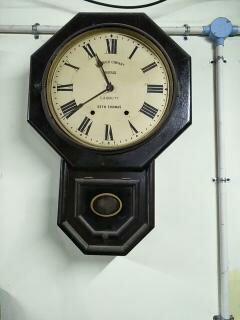
Punkah

old fan

King George V and Queen Mary

Chola dagger

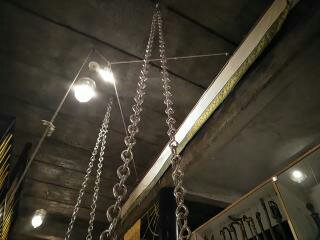
Entrance to the passageway

The tunnel

That evening, we boarded the train after dinner at the resort, at around 8. This trip has been a fun one, and I enjoyed every minute of it with Pradeep Chakravarthy, Priya Thiagarajan, and everyone else who came on the trip with me.