Pages

Pages

Showing posts with label 1857. Show all posts

Tuesday, 25 February 2020

A Walk along the Northern Ridge with Prof. Sanjyukta Datta


The First Heritage walk by the History society for the year took place on 1st February, 2020. Saturday had about 10 of us had accompanying Prof. Sanjyukta Datta in and around the Northern Ridge, visiting various monuments of the region. We had just entered the ridge area through the gate opposite Delhi University at around 11 in the morning and were looking forward to the day ahead.  As we approached the Flagstaff tower, our first stop of the day, Professor Datta informed us that the local Archaeological Survey of India (ASI) team was waiting for us.
The Flagstaff tower was built in the early 19th century and was used to hoist the British flag all the way up to 1947, said Professor Datta. This was where women and children hid during May 1857 when the Meerut rebels/mutineers had taken the city. They later fled from there to Ambala.
The ASI officials allowed us access into the structure. The inside is a single circular room with a spiral staircase in the centre, leading to a first-floor balcony, and finally a terrace on top with a 360 degree view.
Taking some group photos here, we walked down the path to a guardhouse, from the Tughlaq era.
The Southern guardhouse

The ridge has two major groups of monuments: Those from the Tughlaq era, and those connected to 1857 in some way. The guardhouse was a Tughlaq era monument, from when the ridge was Firoz Sha Tughlaq’s hunting grounds, and he had a hunting lodge here (evidence of which survives).
The guardhouse does not leave us with too many clues to the past, and we soon moved on to the Chauburji. This structure takes its name from the four domes that had adorned it in the past, only one of which currently survives. It has a large open area on the ground floor, and the first floor is an open-to-sky mosque with a large platform in the centre. One of the domes is in the corner of the terrace. In the last few years ASI has managed to restore what is left of the structure. Again, thanks to our ASI friends we were allowed to go in and explore.
The mosque on top of the structure has faded inscriptions around the doorway and the motifs have deteriorated over time, but the overall charm remains. Professor Datta pulled out a book on the 1857 events in Delhi, and showed us the photo of the Chauburji from soon after that. It looked quite different from the photo there, with half the building missing, and the structure was quite different. We decided to see if we could identify which part of that mosque coincided with the existing structure. After some effort, we were able to piece together which part corresponded to which, through inference. Here the ASI officials took their leave and we headed on.

We then left the ridge and headed to Pir Ghaib, that combined both eras of monuments; a Tughlaq tower that contained the myth of a 19th century disappearing Djinn, passing the sign to Hindu Rao Civil Hospital on the way.
Hindu Rao was a Marathi and brother-in-law to the Scindias of Nagpur, who had broken away and moved to Delhi. In 1835, William Frazer, a British official, was murdered, and his house on the ridge was acquired by Hindu Rao. The house acted as the headquarters to the British on the ridge in 1857, and later became a hospital (we passed the building a couple of stops later, and the current structure bears little to no resemblance to the early 19th century one).  

Pir Ghaib sits in the middle of modern residences, and looks completely out of place, yet comfortable in its unfamiliarity, like old furniture in a fancy new apartment. The structure was purportedly built in the time of Firoz Sha Tughlaq, again, a part of his lodge, and was perhaps an observatory, due to the holes built into the ceiling.
Pir Ghaib

From here we passed a Baoli, or stepwell of around the same time period, and passing Hindu Rao Civil Hospital (which I had mentioned earlier), in whose vicinity Timur, the Turkic warlord, is said to have pitched his tent when in Hindustan, we arrived at the Ashoka pillar.
Erected by Ashoka in Meerut, this was one of two pillars brought to the Delhi region by Firoz Shah Tughlaq. It contains a series of lines in Brahmi from the time of Ashoka, with a shorter, later inscription below. It was said to have been blown up around the middle of the 1710’s, and was later put back together and deciphered by the British in the 19th century.  After admiring this round rock shaped by a human 2300 odd years ago from all sides, it was time to move to the last stop of the day, the mutiny memorial.
The Ashoka pillar

This was the most modern monument of our walk as well. Built in the 1860’s, it provides a timeline of events for the British recapture of Delhi, as well as acting as a memorial to those who died on the British side during 1857. Later some of us opined that if we hadn’t known better, it could have looked like a church from a distance.(For more on the Mutiny memorial click here) Built at a height, it dominates the surroundings. This was also the area the British set up camp during their retake of the city.
With the walk now over, we all headed our separate ways. Most of us headed back to campus. It took a while for us to realise that the walk had been so long, we had missed lunch. But it didn’t matter. The walk had more than made up for it.  

Flagstaff tower

The path up the ridge as seen from the flagstaff tower


Chauburji

The crumbling mosque atop the Chauburji

The signpost to Hindu Rao Civil Hospital(now much further away)


Hole in the ceiling, possibly for Astronomy at Pir Ghaib


Ashoka pillar

The plaque at the base

Mutiny Memorial 


Locations: 


Hindu Rao signpost (rough location, next to the garbage dump)


This article first appeared in The Edict magazine of Ashoka University, it has been slightly modified for this blog

Sunday, 7 October 2018

Dara Shukoh's library

To be honest, I was not intending to go here. I was doing a series of college visits around Delhi, and was at the Ambedkar university in Old Delhi. This is just South of the Kashmir gate, walking distance from the metro station with the same name, off Lothian road.
Having gone there, we first went to the management building, which struck me to be very much like a British social building. It was a stone, white building, with a very low ceiling. The college was supposed to have moved there very recently.
We then began to look around. And right behind the management building was a massive structure, older than the previous building, with pillars, large doorways and steps leading to an inside veranda with madras terrace roofing. To the left, the room expanded out, and there were shelves at the back, with a glass display to a side - housing a skeleton. There were curved archways(now sealed) leading into a large room at the back. However, repair work was going on then.
This was the library of Dara Shukoh. Currently housing the state archaeology department, I presumed that the front room and entrance-way were a British addition. The ASI stone plaque provides the various uses of the building. But first, a little bit on Dara and his library.

Dara Shukoh was the eldest, and the chosen son of Sha Jahan. Being heir designate, he lived in Delhi with his father, while his brothers were governors of various parts of the kingdom. Dara was given to philosophy. He would interact regularly with Sufi saints, and Hindus.He is supposed to have commissioned a Persian translation of Upanishads(Sirr E Akbar)as well as commissioning Persian works to Sanskrit. However, Dara had little skill on the battlefield, and that was his downfall. When Aurangazebs armies marched up to Agra in 1658, he, in the middle of battle, dismounted and got onto a horse, from an elephant. Seeing the empty Howdah, his soldiers panicked and ran.

Dara himself fled, but a few months later, lost in an encounter with Aurangazebs men. Fleeing, he was betrayed by a nobleman who offered him protection, and jailed by Aurangazeb. While in jail, a group of assailants killed him and his son.

The library was constructed in 1637, and is said to have housed over 2 lakh books. However, popular legend has it that after Daras defeat in 1658,Aurangazeb had the books in the library burnt. Another version goes that subsequent inhabitors destroyed sections of the library. But at this point of time, there are no books in the library.

Aurangazeb gave the library as a residence to Ali Mardan Khan, the governor of the Punjab.
It was purchased from the family of Juliana, a Portuguese tutor to the royal children, by Safdarjang, when he was in Delhi (aroud 1751 )

Then, when a Residency was established in Delhi, David Ochterlony, the first British Resident of Delhi used it as his quarters in 1803.  Later, in 1844, the Delhi college was established here.  It was ransacked in 1857.

Later, the State Archeology Department  used it as an office, and it still belongs to them, with a defunct museum and shelves, apart from a few artefacts still lying around there.

“Most of the artifacts confiscated by the Customs Depart-ment are kept here. They belong to different eras, and have nothing to do with Dara Shikoh or Delhi,” said an official overlooking civic work at the library.(Indian Express, May 12, 2017)


Looking around, in the middle of this calm, electric campus, I hoped this fascinating building will become a museum of Delhi artefacts soon, and not be left to crumble. 
Some articles from recent years:

https://www.thehindu.com/news/cities/Delhi/Battling-time-Dara-Shikoh%E2%80%99s-Library-cries-out-for-help/article17205937.ece

https://timesofindia.indiatimes.com/city/delhi/dara-shukohs-library-to-get-fresh-lease-of-life/articleshow/57980576.cms

https://indianexpress.com/article/cities/delhi/dara-shikoh-library-embodying-the-citys-history-a-library-and-a-church-pulled-out-of-ruins-4651895/

https://www.hindustantimes.com/delhi-news/the-hidden-gem-dara-shikoh-s-library/story-iGW58Dg19VUSXvgwabhS0J.html


Audrey Truschke's book Aurangazeb is another good source for material on Dara's end, as well as City of Djinn's by William Dalrymple

Saturday, 6 October 2018

St James Cathedral

The oldest church in Delhi is the St James'.

Though Christianity came to South India through Kerala, soon after the death of Jesus, North India had just a glimpse of this major religion. Though the Portuguese, French, Dutch and even the English had been in the subcontinent from the time of Akbar, the Mughal capital had no church until the Mughal power was practically non-existent.

Built in Old Delhi by Col. James Skinner, an Anglo Indian,(who has a memorial plaque to his name in the floor of the church) very close to the Residence of the Resident Ochterlony(now in Ambedkar university), and just inside the Kashmiri gate of the fort.The popular story goes that Skinner was lying injured on a battlefield in 1800, and promised to build a church if he lived. The initial cost was around Rs 95,000 is what is believed.
 The design is supposed to have been based off of Ochterlony's tomb, that he had built for himself.  The church was built in 1836, and was in use till 1857, even managing to convert some locals, like Dr Chimmun Lal and a Delhi University professor. However, they were killed in 1857 for their conversion.
Also listed on the walls of the Church are Padre Jennings, the Padre at the church from 1852. A large proportion of the plaques are for those who died in the 1857 massacre.

According to William Dalrymple's 'The Last Mughal' "All the movables from the church...including the chairs and tables and even the marble slabs on the floors were taken away" on 11 May, the day the soldiers entered the city.

During the British take-back of the city, the church came under heavy firing, and was used as a place of defense as well.

A mutiny memorial was built in the church compounds, and the various Skinners interred here in the grounds, in a cemetery (which I surprisingly missed seeing),as well as Thomas Metcalfe and William Frazer.

The Pew was constructed by |Col. Samuel Swinton Jacob, possibly in 1867 or not much later. He was the Chief Engineer of Jaipur and an architect in the Indo-saracenic style.

The church was in use uptil 1931 as the viceroys church, after which it lost some importance.

In 1961, Queen Elizabeth visited the church as part of her royal visit.

In 2016, restoration work began, and has been going well. We could see teams with ladders fixing the doors and lintels in 2018, March.

The church is quiet and neat. The door is to a side, and at the entrance is a wall of photos and news clippings of the church over the ages. Next to that is the caretakers room. Strangely enough, the church has signs everywhere preventing photography, and asking people to remove their footwear before entering.

Inside, the church space is octagonal, with the entrance at the opposite direction of the seating. With the stained glass windows, the paintings, the memorial tablets and the cool floor, complemented by the absolute silence of this unvisited monument, the atmosphere is calming but alert, with a story of over 180+ years, held in a bated breath of a moment inside.
Location: St James' Cathedral


Some further details can be found at:

William Dalrymple's "The Last Mughal"

https://www.hindustantimes.com/photos/india-news/photos-delhi-s-180-years-old-st-james-church-is-crumbling-into-obscurity/photo-sHOPQrPCxa6uD9eVCc2S1I.html

https://www.dailymail.co.uk/indiahome/indianews/article-3634106/Delhi-s-oldest-church-St-James-s-set-revamp-vibrations-nearby-Kashmere-Gate-Metro-damage-foundations.html

http://www.victorianweb.org/history/empire/india/68.html

Friday, 5 October 2018

Mutiny memorial: An 1857 monument in Delhi.

It was a strange day, particularly because the weather was pleasant. And it was Delhi.
Of course, this meant it had to be taken advantage of, so my mother and I set off to see the historic sites of the ridge.`
The ridge is a geographical feature to the North West of Delhi. During the seige of Delhi by the British in 1857, they had set up camp on this ridge. Later, a memorial, known as mutiny memorial was built on it, and a little later, it was declared a protected forest area. Known now as the Kamala Nehru ridge, it houses an observatory, army guard houses, a walking track, the mutiny memorial - and an Ashoka pillar(brought there by Feroz Tuglaq).
Stretching from Lala Hardev Sahai Marg, all the way past the Legislative Assembly complex, to the highway on the other side, and the North campus of Delhi university,with the Dr Karnwal road running through it, it encompasses many acres, it provides much needed green cover to the capital. (which has always shocked me with how green it is, in comparison to many other cities in the country. )

Taking the metro, we got off at Pulbangash metro station, and walked across the road, into the ridge.
The moment you step onto Dr Karnwal road, the drop in temperature is visible, as the road begins to slope upward. Rising up, it goes past a park, and all the way as far as the eye can see, with trees hanging overhead all around. 
As we walked, a Gothic spire suddenly rose out of the trees in the distance. As we got closer, we realised what it was - the mutiny memorial. 
The gate was closed, but a security guard came and opened it for us. Rising up, about 34 metres high, stood the memorial.
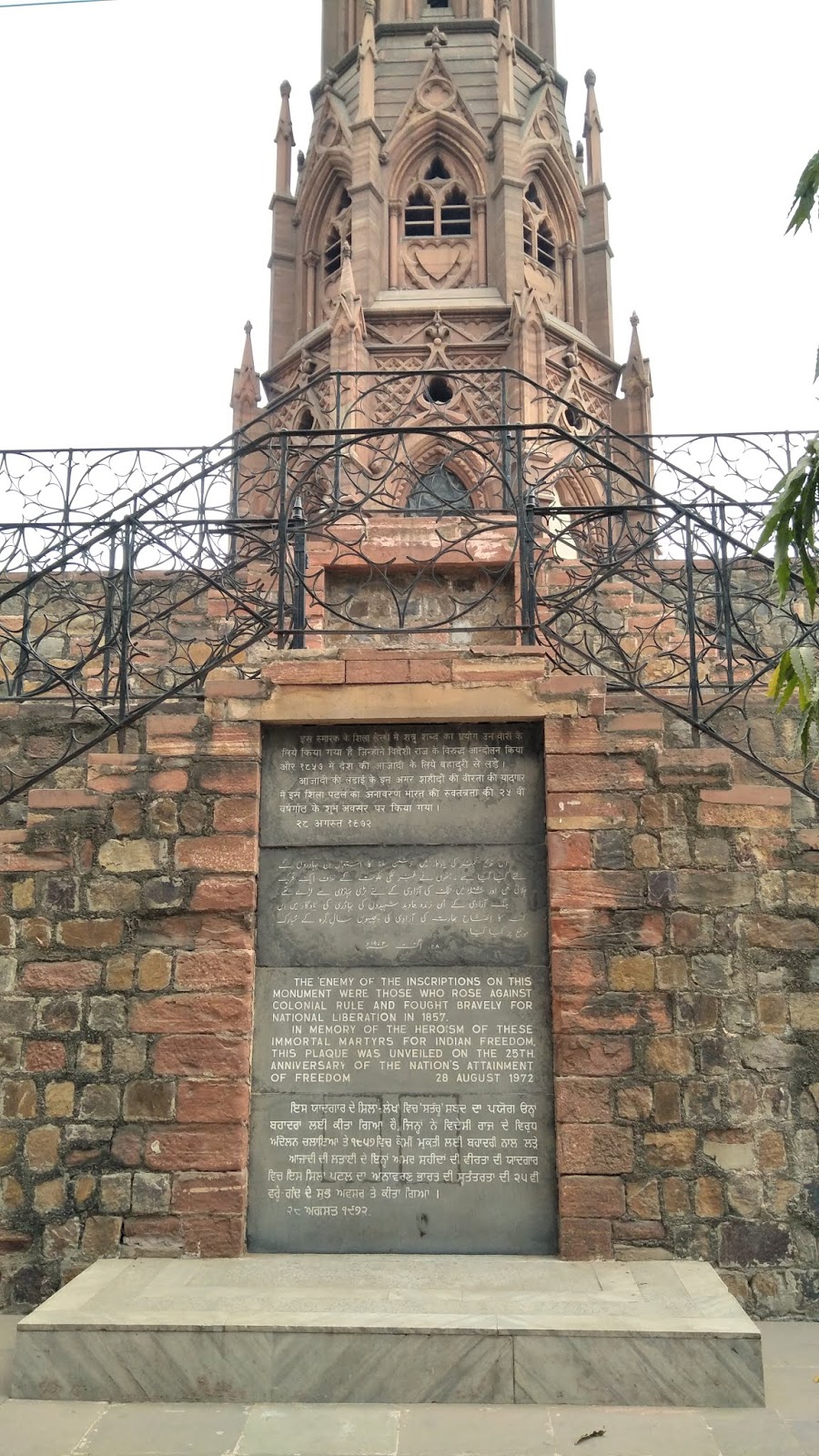
Right at the base, was a board, set up by the ASI, detailing the structure and history of the memorial.
This was where Taylors battery was situated, during the seige, at that very site, it says, and the pillar built in 1863.
 At the base of the turret itself was a plaque put up by the Government of India in 1972, as way of explanation in 4 languages, Hindi, . Its walls bore record of all the casualities the British sustained, European as well as Indian, and a message in four languages: English, Hindi, Urdu and Punjabi, commemorating their victory as well as mourning their losses.
Location: Mutiny memorial

The mutiny memorial


The locked door leading into the turret


The security guard and a dog


We looked around for a while, as friendly dogs lazed around, enjoying a rare pleasant afternoon. 
As we were about to leave, we asked the guard about the Ashoka pillar. He confirmed that it was there, but he said the gate was always locked - but if we wanted, he would come with us, and we could jump over the gate. My mother was in no mood for such tricks, and we returned to Pulbangash, to go back to where we were staying.

Saturday, 12 November 2016

On 1857, Delhi . (Based on 'the last mughal' by William Dalrymple.) Short version (5 stanzas)

The morning of eleventh May
In history a most fateful day
When they rode 'cross the land
As a single man
To meet their emperor
And declare their plan

From the fort he looked out in alarm
The emperor from the fort to Palam
Who looked at them ride
across the wide riverside
who marched to serve him
with a deadly stride.

Into the palace the looters marched
To them ceremony was just a farce
Looked for their king at the Diwan-I-Khas
Where his aide and the hakim they pass
threatened them when they bury christians
and tie their horses in the royal garden.

"Our king we seek your blessing
Our plan it needs no fleshing.
We are here to serve
our religions with verve
and murder those Christians
to your ancient line preserve"

The Shahenshah looked quite worried,
The idle brain of his scurried.
To the mutineers he said
"Go on ahead
and to you I give my blessing"
And so the city bled.