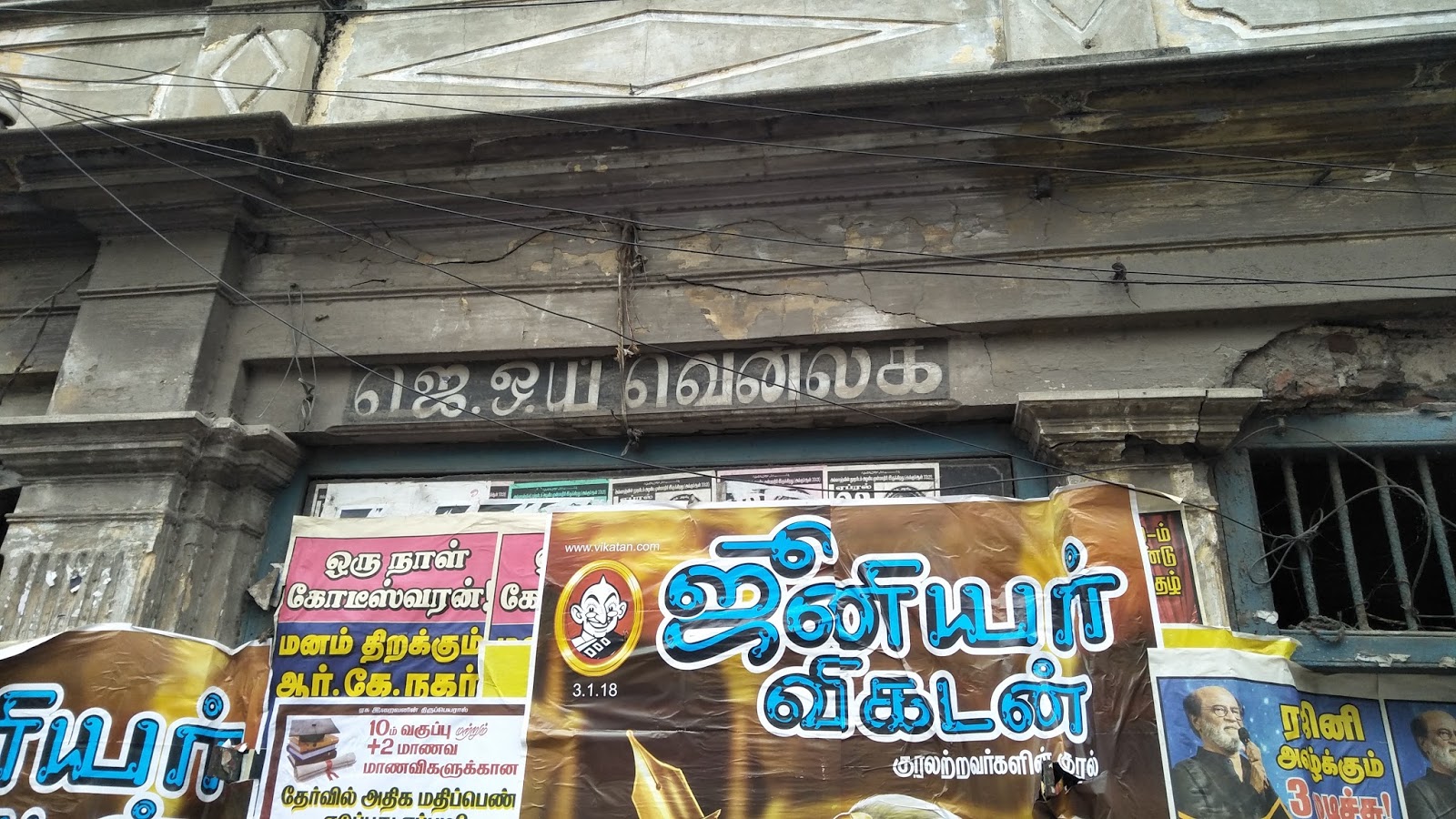
Up at 5, but that is typical walk behaviour. Out at 6. And at the venue 10 minutes ahead of schedule. There is Padmapriya Baskaran, the person who is going to lead the walk, waving at us. We go towards her.
The crowd slowly builds as time goes by, and by the time we are ready to move at least 60 people are ready and waiting. We are off. Though we have assembled at the Dandheeswarar temple, it is to be our final stop. This is a temples walk.

As it is such a large group, Padmapriya is constantly afraid that some of us may overflow onto the road and block traffic and it does happen at times. However, in the end, we get to our first stop, Brahmin street. Here, she talks about how Hari-Hara-Haram (the houses flanking the Shiva and Vishnu temples in a village), with usage, have evolved into agraharam. The Nattar street does not refer to Nadars, but to those who were administrators. Velachery was a Chathurvedimangalam, but that does not mean that it was only occupied by Brahmins and scholars. A village needs every community to survive. Interestingly, there is a 'Telugu Brahmin street; where the Telugu Brahmins lived, as this was a border area between Tamil and Telugu territory.
The first stop we came to was the Vasudeva Perumal temple. The bronze idol from the Pallava time has been moved to a separate temple, and the original, the only temple in Velachery that is a Chola remnant, is a ruin, with a tree merged with it. This had been noted(the ruins) in 1957, but Padmapriya notes that no move has been made after that. (Luckily, or unluckily, who knows?)
As i looked over the sides of the temple, I noticed that there were words, faint, but visible. Inscriptions. I called a few others and showed them. Apparently these haven't been read before!
This temple is believed to be from the Medieval Chola period.


Our second stop was the Yoga Narasimha temple, where Prahalada is supposed to have seen Narasimha (received Darshan). The temple has been completely modernised, and the only trace of its past is in the inscription stones fused with cement to make the benches.
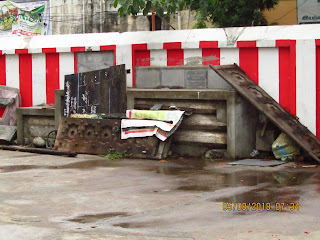

The next stop is a Saptamatrika temple, known as the Selliamman temple, where, though it has been renovated, the inscriptions have been saved and placed against a wall. They are from the time of Paranthaka Chola. However, Padmapriya mentioned, they are missing the phrase, Madurai Konda so they may be his grandsons, Uttama Chola's, son of Gandaraditya, the younger brother of Rajaditya who died in the Thakkolam war, cousin to Rajaraja.


From here we went to the back gate of the IIT campus, where she talked about the temples to be found in IIT. One of them is Jalakanteswara. This is a lingam, found in the campus while digging for construction, and from the Vijaynagar era.
The other is an Amman temple. This is one of the Ellaiamman deities of the village of Tharamani. It was believed that those who were ill were supposed to visit various temples (now) in South Chennai, including this one. The reason for the gate being named Appala Kulam was also explained. The name is actually derived from the fact that a saint, Appaya Deekshitar, had worshipped at the Jalakanteswara temple.
Location: IIT back gate
The next stop was the Jeeva Samadhi of the Chidambaram Swamy. It is quite an interesting story that was narrated to us.
Roughly 200 years ago, a man from South India went around visiting various ancient temples. He reached Velachery one fine day, and saw the Dandeeswaram temple in ruins. An old woman asked him to renovate it, and he took it as a sign from God. However, no one was willing to help him, until they saw a miracle. A cobra came out of the temple, and, as the Swamy slept, covered his face from the sun with its hood. Then they all realised he was a great man and helped him renovate the temple. He is supposed to have paid the workers in Veebudhi, and that converted itself into money.
Finally, when the work was over, he began to leave but the cobra stopped him. So he stayed on.
At a later date, the nawab residing in Madras(maybe the Arcot nawab), fell ill and came to him. As he was cured, he gave him 10 acres of land. (That land is now in the IIT campus). He is supposed to have foreseen his own death in 1858, and died, being buried there. Two of his disciples are buried there, two in Mylapore.

The next and final stop was the Dandeeswaram temple.
The legend goes that, Shiva having saved Markandeya from Yama, takes away Yamas powers in his staff from him. As Yama worshipped Shiva here, and regained the power to take lives here, it is called Dandeeswaram. This is also supposed to be the place where the Vedas purified themselves after being retrieved, so the village was called Vedasreni.
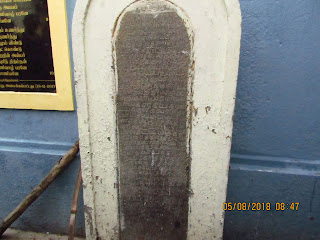
The inscriptions here are from the time of Paranthaka I, which provides antiquity. However, a few of the inscriptions have been sandblasted. There are supposed to be 11 inscriptions here, from the time of Paranthaka I(907-955 CE) to the time of Kopperunjingan(1216-1242 CE).However, the temple is very strict about photography inside, so I was not able to take any, except one from the 19th century, after the renovation by the Chidambaram Swamy.

Having seen all these sites, with so much history(as well as those with history vandalised and lost) we all went home, though some went on the next Madras day event, as is usually the case in that month.
The crowd slowly builds as time goes by, and by the time we are ready to move at least 60 people are ready and waiting. We are off. Though we have assembled at the Dandheeswarar temple, it is to be our final stop. This is a temples walk.

The group slowly assembles, a large one, even though it had rained the previous day.
The first stop we came to was the Vasudeva Perumal temple. The bronze idol from the Pallava time has been moved to a separate temple, and the original, the only temple in Velachery that is a Chola remnant, is a ruin, with a tree merged with it. This had been noted(the ruins) in 1957, but Padmapriya notes that no move has been made after that. (Luckily, or unluckily, who knows?)
As i looked over the sides of the temple, I noticed that there were words, faint, but visible. Inscriptions. I called a few others and showed them. Apparently these haven't been read before!
This temple is believed to be from the Medieval Chola period.


A front view
Location: Vasudeva Perumal This is just a rough location as neither show up on google.

An agraharam house pointed out to us on the way.One of the few houses from around a 100 years ago.

In the centre, the old pillars can be vaguely made out

She pointed out to us, the word "Chandradittavarai" which means, "as long as the sun and the moon are in the sky.
Location: Yoga Narasimhar


The inscription stones, now kept carefully to the side.
Location: Selliamman temple
The other is an Amman temple. This is one of the Ellaiamman deities of the village of Tharamani. It was believed that those who were ill were supposed to visit various temples (now) in South Chennai, including this one. The reason for the gate being named Appala Kulam was also explained. The name is actually derived from the fact that a saint, Appaya Deekshitar, had worshipped at the Jalakanteswara temple.
Location: IIT back gate
The next stop was the Jeeva Samadhi of the Chidambaram Swamy. It is quite an interesting story that was narrated to us.
Roughly 200 years ago, a man from South India went around visiting various ancient temples. He reached Velachery one fine day, and saw the Dandeeswaram temple in ruins. An old woman asked him to renovate it, and he took it as a sign from God. However, no one was willing to help him, until they saw a miracle. A cobra came out of the temple, and, as the Swamy slept, covered his face from the sun with its hood. Then they all realised he was a great man and helped him renovate the temple. He is supposed to have paid the workers in Veebudhi, and that converted itself into money.
Finally, when the work was over, he began to leave but the cobra stopped him. So he stayed on.
At a later date, the nawab residing in Madras(maybe the Arcot nawab), fell ill and came to him. As he was cured, he gave him 10 acres of land. (That land is now in the IIT campus). He is supposed to have foreseen his own death in 1858, and died, being buried there. Two of his disciples are buried there, two in Mylapore.

Location: Chidambara Swamy Jeeva Samadhi
The next and final stop was the Dandeeswaram temple.
The legend goes that, Shiva having saved Markandeya from Yama, takes away Yamas powers in his staff from him. As Yama worshipped Shiva here, and regained the power to take lives here, it is called Dandeeswaram. This is also supposed to be the place where the Vedas purified themselves after being retrieved, so the village was called Vedasreni.
The inscriptions here are from the time of Paranthaka I, which provides antiquity. However, a few of the inscriptions have been sandblasted. There are supposed to be 11 inscriptions here, from the time of Paranthaka I(907-955 CE) to the time of Kopperunjingan(1216-1242 CE).However, the temple is very strict about photography inside, so I was not able to take any, except one from the 19th century, after the renovation by the Chidambaram Swamy.

The Gopuram opposite which we assembled.

A 19th century inscription outside, which meant I could take a picture of it.

The temple tank.
Location: Dhandeeswarar temple