Pages

Pages

Showing posts with label 18th century. Show all posts

Monday, 2 March 2020

History and Society in Sonepat


It was last Sunday that Revanth had invited me to Sonepat to explore its monuments. Revanth was a fellow history enthusiast, and a third year at Ashoka. He was documenting the monuments there, and he and I were headed for the initial trip to check out the town and see what we could see.

Leaving campus at 9, we walked to the highway where we caught a share auto heading to Sonepat. The share auto had two rows within it at the back and space for two next to the driver. Packed in there, we got to the town in about 20 minutes. Revanth was pretty impressed with the layout of the town on google maps, and its grid structure, but that was the last time either of us were pleasantly surprised by the town. 

Our first stop of the day was the tomb of Khwaja Khizr, behind the Khwaja Khizr park. The tomb dates back to the time of the Lodis, and is not too elaborate in construction. In front of it is a 4 acre public park that provides access to the monument. 

The tomb of Khwaja Khizr, 1520's Lodi era

The monument is accessed by a flight of stairs and a large gateway that leads to a large courtyard. In front of the stairs is an open to sky brick platform with two tombs. Built between 1522 and 1524, this tomb was built for the Sufi saint Khwaja Khizr son of Darya Khan Sarwani. There are a lot of floral motifs used around the structure.
The park was filled with people of all ages, divided according to age roughly. The young boys (and the occasional girl in their group) were playing their own games, the older boys were playing cricket, and the old women were sitting and talking amongst themselves. 
As we entered the park, a group of young boys were playing with a puppy, running around with it, and picking it up and moving it around on the single pathway approaching the monument. The pup could hardly move, and would waddle after the boy who clicked his fingers at the dog, jumping backward as he did. Revanth approached them and took some selfies with the pup, and struck up a conversation with them. As we moved towards the monument, he noted that the boys playing there were all upper caste, with names like Sharma and Khatri. In rural - or semi-rural as Sonepat was - Haryana, caste discrimination is pretty high. 
Just then a ball from the older boys who were playing cricket struck Revanth's bag. The boy who'd hit the ball came forward to apologise, but Revanth was not too upset. 
As we climbed the steps of the monument, an old lady, one of a group sitting at the base of the monument, asked him if he was ok, having seen him get hit. She then asked him why he hadnt gone on to scare or threaten them a little. We later talked about this, and realised this sort of thinking is practically absent in South India where people are just generally much nicer. 
The tomb structure has inscriptions all around, and over every door structure. The floor was covered in pigeon shit, which of course I had to step on when i went in.  

The tomb of the Sufi, with another tomb beside it, not visible in the photo

After we left the monument, stopping for a while at the buffalo pen next to it, and watching two bulls fight, we walked through the town. Both of us were amazed at the lack of aesthetic the town had to offer, and the essentially rural quality it had. There were hardly any vehicles on the road, E-rickshaws plied quite regularly but apart from them there were not too many cars or other vehicles. Houses were small, and only the upper caste had big houses. People were relaxing by the roadside, smoking hash and cigarettes. 
We walked along the streets, getting thoroughly confused in the maze-like alleyways. Hardly any of the monuments on our list were marked on Google maps, and some had multiple generic markings. We ended up at a main road just as it started to rain, so we took an auto back to Delhi road where the share autos ply towards Ashoka. 
Of course, just as we reached Delhi road the sun came out. So we went into a roadside cafe and had a snack. Realising it was economically unfeasible to return to the town area, we asked about the Durga mandir, that was originally a mosque (not in that way, but the temple was a mosque). 

Tucked away in a narrow gully by the main road, the minarets of this temple peek out from behind houses. When we first tried to enter, we passed the entrance to the gully. When we arrived, we almost missed the temple. The front of it has a large boards covering the minarets and domes, which confused us. As we entered, an old man greeted us with 'Ram Ram'. The next exchange had us very confused. "Whats in the temple?" he asked us. We both weren't sure what to respond. "Nothing" he replied himself, and left. 
In an old area called Mohalla Khan lies the mandir/masjid. The area's antiquity is vouched for by the intricate doorways seen around. The mosque was built during the decline of the Mughals in the 18th century. It was in use till the time of partition, when the Muslims (of then-Punjab) crossed over to Pakistan. Even after it became Haryana, the mosque remained in disuse. Of late, it has been used as a Durga temple, though slowly all evidence of its history are being erased. 
The inside shows no evidence of a mosque, and the entrance area just outside the temple/mosque is filled with other constructions. The whole place is tiled up, and it could well be a twenty year old temple if not for the minarets and the domes. 

It seems from a few articles that I later went through, that its only in the last decade that the inside was modified and the front covered. The first link, though with terrible grammar and bad photos, gives one an idea of the place in 2013. 

Revanth was insistent on a good photo of the domes. So we went around the side streets. Finding a decent location on a slope, we clicked some. But he was not satisfied. If only we could enter one of these houses and go to a terrace, he reminisced. Finally he built up the courage when two children entered a house. He asked them for those inside and they were quite nice people. A woman came and talked to us, and she gave us permission. Though there was also a man, it was the woman who seemed to have more say. As we noted, the women of Haryana seemed much tougher and able to hold their ground better, than women in the South, for the most part. They let us go to their terrace and take photos of the domes. After reading the article in the second link, I'm not so confident they will survive for many years to come. 

We then left for college, thanking the owners once again. We would definitely be back another day, to complete our quest to explore Sonepat's monuments. 

The domes and minarets as seen from the back, from a stranger's terrace, 18th century Mughal


Places: 


Links: 


Sunday, 26 May 2019

300 years of the first Anglican Church of Bombay, or. The Church of Churchgate


The view from the doorway


In 1662, Charles II married Catherine of Portugal,and as part of his dowry received the islands of Bombay.

At first Bombay was merely a bunch of uninhabited islands, but as they began getting connected and built on, the importance of Bombay to the British rose. And so did the need for a permanent place of prayer.  Work soon began on its first Cathedral, the St Thomas Cathedral in the fort. In the 1670's work was begun, with donations. After three years however, it came to a standstill (in 1677), when the Governor died. The Cathedral was left with only a few metres of wall built. It was in 1715 that the Chaplain, Richard Cobbe,  resumed construction of the structure. The structure was finally completed in 1718 and inaugurated Christmas day, that year by the Governor, Charles Boone.

A plaque commemorating Cobbe, below which, a plaque put up when the church was rededicated, 2003, after restoration

The Cathedral served as the primary place of worship for the English stationed in Bombay from the year 1718 onward. It also serves as zero-point for the city, when measurements were taken. The exact spot in the church premises is commemorated with a plaque.

The Zero point plaque

According to a LiveMint article, the church also serves as a place of record for all baptisms, marriages and burials across the Bombay Presidency, which is an area comprising most of modern Maharashtra, parts of Gujarat, Madhya Pradesh and Karnataka.

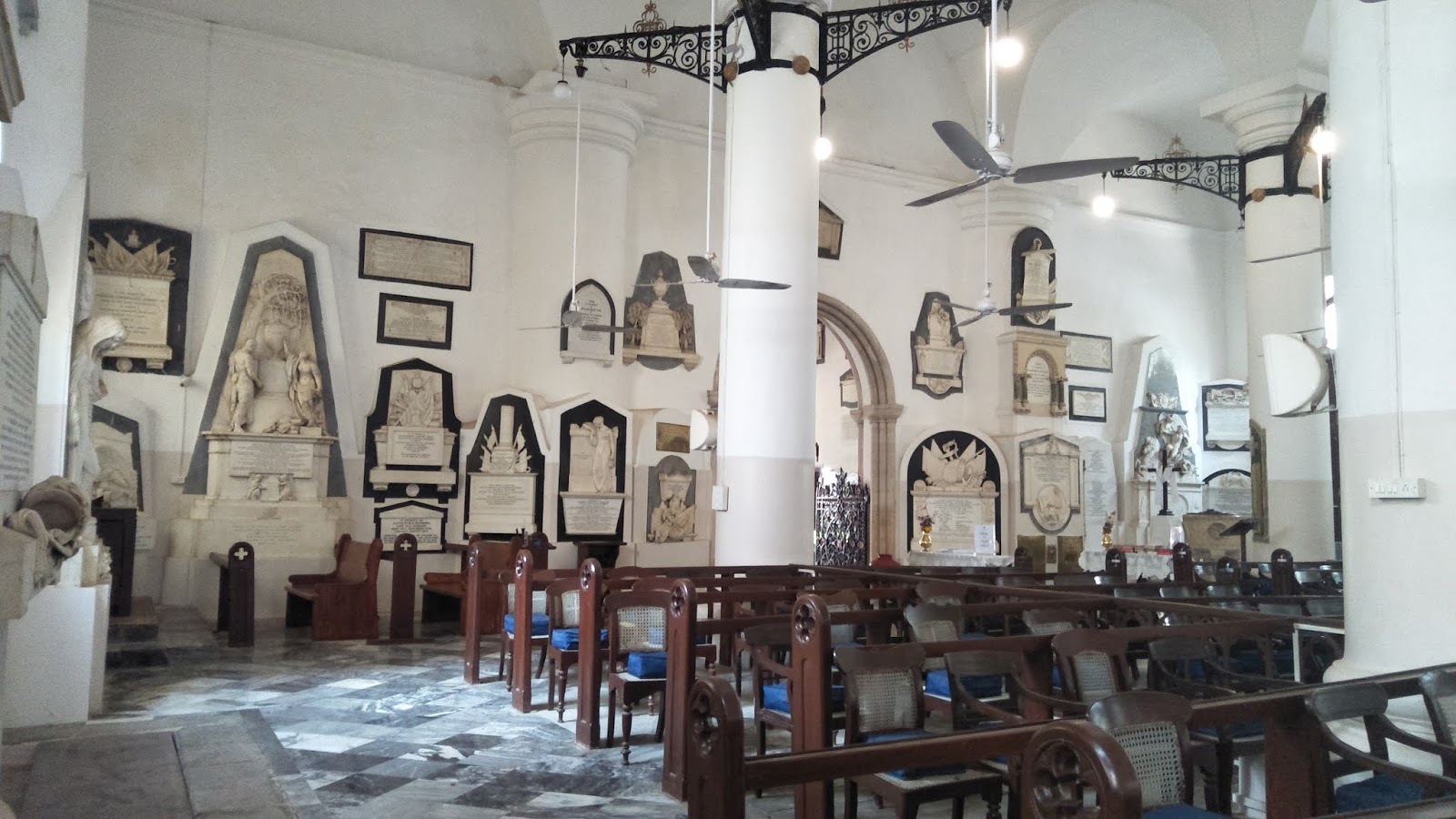
The walls, covered with plaques 


In 1837, the Cathedral was consecrated and the first Bishop of Bombay, Thomas Carr, appointed.


Now, many of you would have been to, or at least heard of, Churchgate station in Colaba. This, the St Thomas Cathedral, is the Church of Churchgate. The gate of the fort closest to the church was known as Church gate, which is what the station was named after. However, the church gate came down in 1862 along with the rest of the fort walls, to allow expansion.

The stained glass. I later read that a replaced panel sports an image of a local train and churchgate station!

Inside the church building, many people have been buried, or have memorial slabs in their name. From an Early Editor of the Times of India, to Governors of the 18th century, to military men, to the first recorder of Bombay, to various judges and leading lawyers, there are many different personalities of Bombay's history remembered here. These memorials also serve as a reminder of the various wars fought by the Bombay regiments, and the wars in the Presidency, from the wars with Tippu, all the way to the Second World War.

Quite a few ships were wrecked in storms off the coast. This one commemorates those who died in the wreck of 'Cleopatra', in 1847 off the Malabar coast

A few of those remembered here are:


  • Thomas Carre, he first Bishop of Bombay. He has a life-size statue of himself, lying down, with a plaque below, right beside the alter

The grave of Carr, died 1859


  • Lucretia Georgiana Brown West, the Widow of a Chief Justice of Bombay, died 1828


  • A memorial to all those in the Royal Indian Marine who died in World War I


  • A memorial to all those from Bombay who died in World War I


  • Captain Leiutenant George Warden, who was involved in various military activities, from 1794 -1807. These activities involved his first duties against the Coolies under Colonel Little(was this a revolt he subdued?) in 1794, to taking Colombo(1796), to the battle of Sedasheer, to the battle of Seringapattinam, to the destruction of the fortress of Jemaulabad (all in 1799), the expedition to Egypt (1801) and the Seige of Baroda(1803). In 1807, H Newham, Secretary to the Government publishes the condolence message that appears on his epitaph, in the Asiatic Annual Register, 1808. 


  • Henry Curwen, Editor, Times of India, who died 1892 on the way back to England. He had bought the newspaper in 1890, in association with Charles Kane. It was sold in 1792. 

  • Sir William Syer Knight, the first Recorder, or Kings Justice, of Bombay. Barrister at Law of the Society of Middle Temple, he died 1802

  • Thomas Mostyn, a Resident at the Mahratta Court, died 1779. 

  • Robert Ashmead Billamore, who, apart from his military duties was Persian interpreter to the Poonah subsidiary force. A son of a noted General, he died in the 1818 war against the Mahrattas at Jaulnah, 7th May. 

  •  Colonel John Campbell, who held Mangalore against the armies of Tippu Sultan for 18 months. He died in 1784.

  • Hon. Jonathan Duncan, the Governor of Bombay from 1795-1811. He was appointed there as recognition for having abolished Infanticide in Benares and Kathiwar. He died 17th August 1811 in Bombay. The monument here was built out of public respect in 1817

  • Major Eldred Pottinger, one of those few people actually buried in the Cathedral. Made a hero when, in 1837, he provided intelligence to the British at Kabul on the Seige of Herat by the Persians, with Russian aid. He was within Herat and disguised. Afterwards, he was made famous by the British as 'The Hero of Herat'. Just before the revolt at Kabul, in 1841, he had arrived at Charikar and encamped with a Gurkha regiment, North of Kabul. On 3rd November, the uprising began, and the following night, they fought their way to the garrison at the base of the hill. After two weeks they made their way to  Kabul, which only he and one other reached on 15th November. After the death of the British envoy, Sir William McNaghten, he was appointed British envoy to the Afghan court, and negotiated a withdrawal. However, while retreating many died from the cold and the Afghanis who followed them and shot at them from the high mountain passes. The ruler of Kabul, Akbar Shah, then took hostage all the women and injured, including Pottinger, and due to this, he survived the following massacre. Taken to the Bamiyan fort during the counter-attack by fresh British troops from the Presidencies, he connived with his captors, and took control of the fort. Once released and, returning to India, he received no rewards or mention, and resigned from the Company. He went to Hong Kong, where his uncle was the first British governor, and died there in 1843, a little over a year later.

One among the famous masses, hidden behind chairs, this was the best view I could get

                                             The Cathedral received heritage status in 2003.


 It is now maintained extremely well, and is a part of Bombay's living heritage. Open throughout the day, from 7-6, it is definitely a must-see if you are looking at Bombay's heritage, or architecture. Though quite a silent place, the history within it is loud, and reverberates.

Location, here


The pulpit
The Baptismal font

A model of the church

The fountain and the entrance